
From Global Playbooks to Local Execution: Four Ecosystems, One Macau Opportunity
Consider this the kickoff for Startup Ecosystem Analysts. Our analysts—in Portugal, the UK, Vancouver, and Tokyo/Seoul—work in three phases: exploration → deep dive → connection to Macau. We first learn each city’s landscape, then publish articles and cases, and finally propose pilots and partnership ideas relevant to Macau. Expect updates on our blog and social channels as we translate global lessons into local impact.
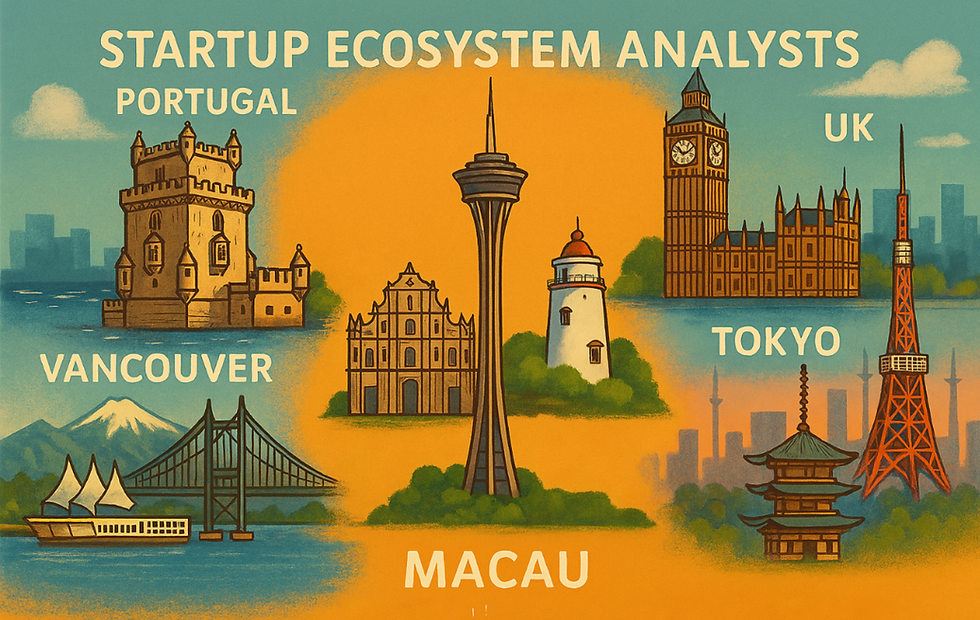
Across the UK, Canada, Portugal, and Korea, the winning pattern is surprisingly consistent: strong ecosystems do not just “support startups” — they build a conversion system.
Idea → Proof → Credibility → Distribution → Scale
Macau’s opportunity is not to replicate any of these models, but to compose a Macau-specific pipeline that turns its cross-border position into repeatable outcomes.
1. UK: Regulation Becomes Growth Infrastructure
The UK’s edge is not just capital - it is institutional trust and regulatory clarity. In fintech, health and deep tech, founders win by proving they can operate inside strict constraints.
What stands out:
Clear compliance thinking early
Structured pilots that look like real deployments
Governance that reduces perceived risk for partners and investors
Macau Insight: If Macau wants stronger fintech/health/regulated innovation, the bottleneck is not ideas—it is trust infrastructure: pilots, compliance guidance, governance, and measurable outcomes that investors and partners can believe.
2. Canada: Participation Creates Momentum, Platforms Create Scale
Canada’s strength is making entrepreneurship feel accessible early, then pushing teams toward platform and ecosystem scale (not one-off products).
What stands out:
A wide founder funnel (students, builders, communities)
Rapid prototyping norms
Scaling through platforms, integrations, and ecosystem partnerships
Macau Insight: Macau can expand its startup base fast by institutionalizing maker culture—regular hackathons, demo days, student venture studios—and by teaching founders to build platform-like distribution (APIs, partnerships, repeatable go-to-market), not just “a product.”
3. Portugal: Small Markets Win With Proof, Not Noise
Portugal shows how a smaller hub can still produce global leaders by prioritizing proof—validation that survives scrutiny—then scaling internationally by default.
What stands out:
Validation as a core strategy (not a marketing add-on)
Credibility that unlocks partners and capital
Global expansion designed early because the home market is limited
Macau Insight: Macau should actively design “proof pathways” (clinical, enterprise, education pilots) so credibility becomes an ecosystem output, not a founder’s personal struggle. Small markets must be global by design, not global “later.”
4. Korea: Distribution + Monetisation Turns Culture Into Venture Scale
Korea’s webtoon model is a lesson in building distribution rails and monetisation mechanics early, then using IP expansion to multiply value.
What stands out:
Built-in distribution channels
Clear monetisation mechanics
IP flywheel (successful content multiplies across formats)
Macau Insight: Macau has cultural assets, tourism traffic, and storytelling potential—but lacks an “IP-to-scale” engine. The lesson is: culture becomes venture-scale only when paired with platform distribution, localisation, and clear monetisation.
The Macau Bottom Line: Stop Building Programs. Build a Pipeline.
Macau’s advantages are real—cross-border adjacency, bilingual links, dense institutions—but they’re not automatically “venture outcomes.” The practical question is: what system repeatedly turns Macau teams into fundable companies with export routes?
Proof (validation with measurable results)
Credibility (institution-ready governance and materials)
Distribution (real routes into bigger markets)
The clearest lessons from the UK, Canada, Portugal, and Korea point to four moves:
1) build trust infrastructure so regulated-sector pilots and “institution-ready” standards reduce investor doubt; 2) widen the founder funnel with predictable formation cycles that create momentum and faster learning; 3) institutionalize validation so results become portable proof (data, case studies, ROI) rather than pitch narratives; and 4) design distribution rails—partnership channels, cross-border routes, and IP pathways—so scaling is not left to individual hustle. Do that, and Macau’s niche market stops being a ceiling and becomes a forcing function for sharper execution and faster internationalisation.
Next, we’ll publish deep‑dive articles and cases (UK/Canada/Portugal/Korea) with Macau implementation checklists and downloadable templates. Follow the blogs or visit: macaostartupclub.com/startupecosystemanalysts.


